Case Study
·
CPaaS
Improving buyer fit without chasing more leads
How a CPaaS startup grew qualified pipeline with broadly flat paid spend
A freelance growth engagement with an API-first communications startup in India. Inbound typically began through a trial signup or demo request. Buyers could evaluate its WhatsApp and SMS APIs through a 14-day trial, with sales joining larger or more complex evaluations.
The brief was to grow marketing-sourced qualified pipeline without materially increasing acquisition spend.
Marketing-sourced qualified pipeline
MQL to Sales accepted
First-week activation among trial workspaces
(completed and verified a representative transactional workflow)
Companies entering through trial/demo
Paid cost per sales-accepted company
Anonymized under NDA. Figures are approximate, rounded and/or indexed.
I started with the pipeline number
For this team, marketing-sourced qualified pipeline meant the value of sales-qualified deals attributed back to marketing.
I broke that into two parts:
Qualified pipeline = qualified opportunities × average opportunity value
Average opportunity value had been fairly stable, so I followed opportunity creation backwards:
Qualified opportunities ≈ companies entering through trial/demo × (trial/demo company → MQL rate) × (MQL → sales-accepted rate) × (sales accepted → qualified-opportunity rate)
One company could have several people involved in an evaluation. Commercial progression was read at the company level, activation at the trial-workspace level, and pipeline at the opportunity level.
Trials were a separate product path. Not every commercial evaluation went through self-serve, and reaching product value did not necessarily mean the company would become an opportunity.
The inbound mix looked very different downstream
At baseline, website activity and the number of companies entering through trial/demo were broadly within the recent ranges I compared. Average opportunity value was also fairly stable.
What varied much more was what happened after companies came in.
I grouped those companies by company type and the use case they were evaluating, then compared what happened further down the funnel.
Mid-market fintech and marketplace companies evaluating recurring transactional messaging represented roughly a quarter of companies entering through trial/demo, but contributed around three-fifths of qualified pipeline.

At the other end, very small companies, resellers, promotional senders and unclear use cases made up close to half of the companies coming in, but contributed only a small share of pipeline.
The marketplace companies were interesting because they did not fit the narrowest version of the market definition we had started with, but they performed well commercially.
What they shared with the stronger fintech companies was more useful than the industry label itself: recurring transactional messaging, meaningful volume and technical ownership. The stronger companies also tended to have a reason to evaluate now, such as an upcoming launch, growing message volume, delivery problems, a new channel requirement or an active vendor change.
That gave us a more useful way to decide where to put more weight.
I also checked acquisition source against the same downstream outcomes. Some broader paid activity generated relatively cheap trial and demo conversions but brought in more promotional use cases, very small companies and reseller demand. Higher-intent search and narrower campaigns produced less raw response, but a larger share of those companies made it through sales acceptance.
Cost per form was useful. It just was not enough to tell me whether the spend was working.
The stronger companies were still getting stuck in the trial
At baseline, first-week activation was around 44% among trial workspaces from the stronger transactional group, compared with roughly 24% for the rest.
I looked at where those workspaces were stopping.

Trial started
Credentials / channel configured
Representative API request accepted
Final delivery state observed
Delivery verified

A first successful API request would have made these trials look considerably healthier than they actually were.
For the transactional workflows these teams were evaluating, getting a request accepted was only part of the job. They still needed to know whether the message was delivered and have enough visibility to understand what happened when it was not.

For this engagement, I treated activation as:
a trial workspace sending a representative transactional message and verifying its final delivery state within the first seven days.
That still left half of the 14-day trial to continue the evaluation.
The events showed where workspaces stopped. Stalled-trial conversations, sales notes and product feedback added context around those points.
Some teams struggled around setup. Some managed to send a request but never got as far as verifying delivery. In other cases, the technical path was there but the evaluation had lost momentum or had no clear owner.
Some of the friction was in the product journey. Some was around ownership, urgency or the evaluation itself.
Some activated companies still stalled commercially
Activation showed whether a trial had reached a useful product outcome. Some companies with activated trial workspaces still failed to become qualified opportunities.
For companies that had been in the funnel long enough to progress, I looked at movement from MQL to sales acceptance and then to qualified opportunity, together with the reasons they had been rejected or stalled.
Where stage history was available, it helped show whether a company had progressed quickly, been rejected early or spent much longer between stages.
The earlier losses tended to look different: low expected volume, promotional-only messaging, reseller economics, no technical owner or no real project yet.
Companies that got further were more likely to stall around implementation scope, production economics, security or vendor review, internal timing or approval.
Those differences gave us better context for what to change next.
We narrowed who we put more weight behind
For the next cycle, we prioritised mid-market fintech and marketplace companies with recurring transactional messaging, enough volume for reliability and visibility to matter, a technical owner who could evaluate the API, and a reason to evaluate now.
The use case mattered as much as the vertical.
A marketplace handling high-volume payment and order notifications could be a stronger opportunity than a fintech using messaging occasionally for promotions.
Broad acquisition that repeatedly produced cheap but weaker-fit conversions received less weight. Higher-intent search and narrower company/use-case targeting received more.
The message got more specific too
The original message was broad, but reasonable as category copy:
Across the stronger companies, the evaluation was usually more specific: could an important transactional workflow run reliably in production, and would the team have enough visibility when delivery did not go as expected?
So the message moved closer to that.
For engineering, one execution focused on the gap between an API request being accepted and the message actually being delivered.


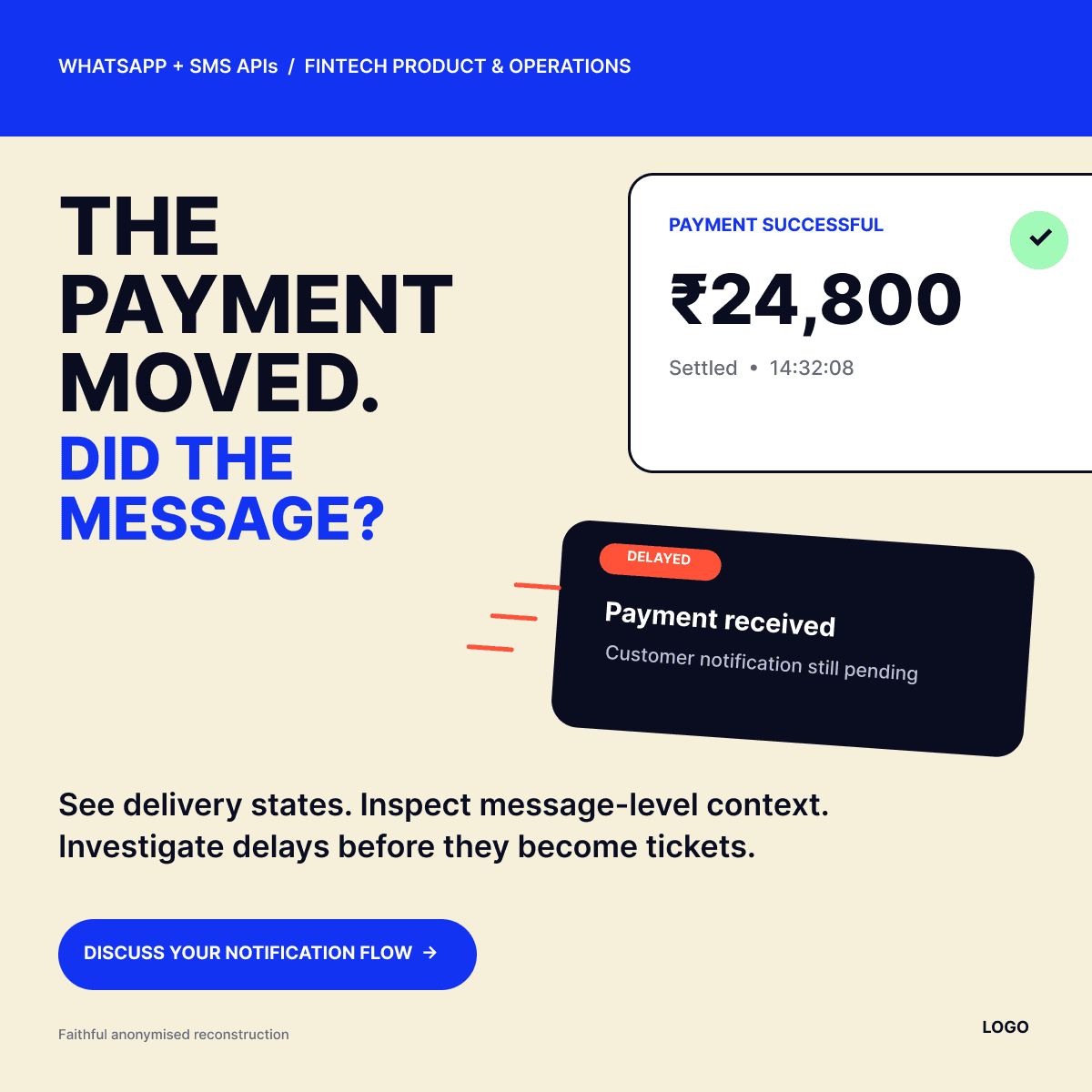

The proof stayed concrete: delivery states, callbacks or webhooks, message-level visibility and enough information to investigate failures.
I screened three message directions first
Before changing the main landing-page experience, I compared three broader directions under similar paid conditions: platform and channel breadth, cost and vendor consolidation, and transactional reliability with delivery visibility.
Cost and consolidation got the strongest immediate response, but more of those conversions came from price-sensitive or weaker-fit companies.
Transactional reliability produced fewer trial/demo requests, but a stronger sales-accepted mix.
Copy and creative changed together here, so I treated this as a directional read on the whole message package.
That was enough to take the reliability direction into a tighter page test.
Form conversion barely moved
The page test compared the existing landing-page experience with a version built around transactional reliability and more concrete proof.
The form rate was almost identical.
The larger differences showed up afterwards. More known conversions were accepted by sales, and more trial workspaces in the treatment cohort reached activation.
The activation figure here is for the page-test cohort. The broader post-change trial cohort is the ~51% result shown at the top.
There was one limitation in taking the experiment all the way to company and opportunity outcomes.
The page variant was assigned to an individual visitor before we necessarily knew which company they belonged to. Two people from the same company could therefore see different variants and later end up inside the same commercial evaluation.
I treat the experiment as strongest evidence about the page experience itself. The later company and opportunity outcomes are useful supporting signals, but not as clean a causal read.
The trial work followed where people were getting stuck
With product and engineering, I mapped the trial around the actual transactional job: configure the relevant channel or credentials, send a representative transaction, observe the delivery state, verify the result, and understand what failure looked like.
The guidance then depended on where the workspace had stopped.
Someone who had not configured credentials needed different help from someone dealing with an authentication failure. A workspace that had sent successfully but never checked the final delivery state had another gap.
Sales-assisted companies could still get technical help. The activation milestone stayed tied to completing the product workflow.
What changed
The main results are already at the top, so I will not repeat them here.
Two other funnel measures help with the read:
Trial/demo company → MQL
Sales accepted → qualified opportunity
Average qualified opportunity value stayed broadly stable.
So the useful combination was this: fewer companies entered through trial/demo, opportunity value stayed fairly similar, and a larger share of those companies progressed through the commercial funnel.
That points to most of the pipeline improvement coming from more qualified opportunities being created from the demand already entering, rather than from more inbound volume or materially larger deals.
Even with fewer companies entering through trial/demo, the improvement in progression rates was enough to produce materially more qualified opportunities.
Acquisition mix, message, trial guidance, qualification and normal sales execution were all moving during the period.
How I read the result
The segment analysis showed that some company and use-case combinations were associated with much stronger downstream outcomes. It does not tell me that the segment label itself caused those outcomes.
The first message screen was directional because the copy and creative package changed together.
The page test gives me stronger evidence about the experience people saw. Once company matching, multiple people, sales activity and opportunities enter the path, the causal read gets less clean.
The overall before-and-after result includes several parts of the work plus normal sales execution. I see the pipeline movement as the system moving in the right direction, not something I can cleanly assign to one campaign, page or trial change.
What I owned
My scope covered the diagnosis and the work that followed from it: funnel and segment analysis, research around stalled evaluations, market prioritisation, positioning and customer-facing copy, experiment design and measurement, and recommendations around the trial and qualification loop.
I worked with sales on qualification and commercial feedback, product and engineering on the trial workflow and technical proof, and design and web support on the customer-facing executions.
Product, engineering, sales and design owned or shared implementation in their respective areas.
What I’d change now
I’d make company identity cleaner earlier so several contacts, trial users and later sales activity could be tied back to the same company more reliably.
I’d also preserve stage-entry and exit history more consistently instead of reconstructing parts of the progression later.
For experiments where the outcome I cared about was company-level, I’d keep people from the same known company on the same variant where possible, while preserving the original exposure for anonymous visitors who were identified later.
And I’d follow activated trial cohorts for longer. The first-week milestone was useful for evaluating the trial, but I’d want to know how strongly it predicted sustained production usage, retention and expansion.